Blog
The 3 to 2 nap transition: what it actually looked like
There’s a point, usually around six or seven months, where the third nap stops working. Every article says it happens “somewhere between six and nine months.” That’s a three-month window, and it’s no help at all when you’re in the middle of it.
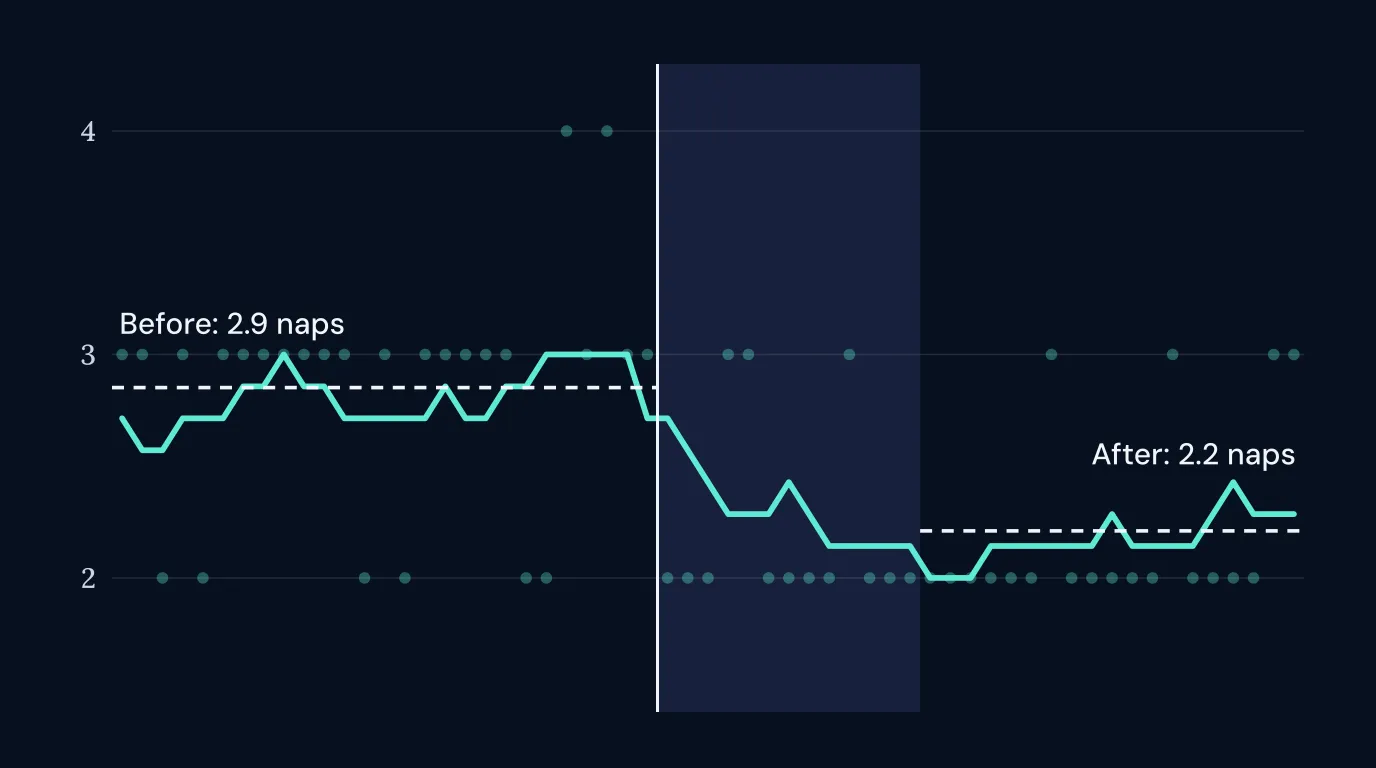
Our son Cedric dropped his third nap in thirteen days in late July, straight after a month of travel and teething. We barely had to think about it, because Ceddie was keeping track for us. Here’s how it went, first from Amanda’s side and then from the data.
Part one: the transition I didn’t have to think about
— Amanda
By the middle of July, Cedric was almost seven months old, and we’d had quite a month: two four-hour flights, a seven-hour road trip, and two new bottom teeth.
Visiting family was worth it. But a lot of my time was spent soothing a baby who was upset when he was awake and very resistant to falling asleep.
By the time we got home, the teething discomfort had eased. I wasn’t thinking about what came next. I was just glad we’d made it through the trip.
A nap transition was nowhere on my radar.
We built Ceddie Sleeps to help with exactly this kind of mental load. But this was the first time I’d watched it help us through a nap transition of our own.
Ceddie saw it coming
I’d heard friends talk about dropping from three naps to two. I’d read about the back-and-forth, the naps that suddenly became a struggle, and the uncertainty about whether it was time.
After travel and teething, I didn’t have much room left to think about any of it.
On July 11, Ceddie put up a card:
Cedric's shift toward a two-nap schedule
At 6 months old, Cedric is showing signs of transitioning from three naps to two. His average wake windows are stretching to 2h 43m, helping him consolidate his daytime sleep into longer blocks like today's first nap of 1h 30m.
A week later, another note pointed out that he was already having a mix of two-nap and three-nap days.
I hadn’t noticed the pattern. I’d been thinking about the nap in front of me: whether he’d take it, how long it would last, and what we’d do afterward.
So when a two-nap schedule appeared, it felt like something we’d been given a little time to expect.
Then the schedule changed
On July 21, Cedric’s schedule had two naps instead of three.
I didn’t make that call, and I didn’t have to do the nap math I loathe. Ceddie had built the day with longer wake windows and more time for each nap, along with a note explaining the schedule:
Cedric had a very restorative night sleep with just one brief waking and went down easily for his first nap of the morning.
We expect this nap to run for about an hour and a half, but you can let him sleep up to one hour and fifty minutes if he needs the extra rest.
This steady start sets a great tone for his evolving two-nap rhythm.
That explanation mattered to me. I could see what the day might look like and understand why it had changed.
I still had a baby to settle, naps to log, and a day to get through. But I wasn’t starting from scratch every time I opened the app.
Wobbly days still happen
Of course, like most things baby-related, our nap transition wasn’t a straight line. There were days he needed a third nap again.
Before this, I would have wondered whether that meant we’d moved too soon. Should we go back to three? Try to stretch him to bedtime? Start over tomorrow?
One afternoon, his second nap was just 25 minutes in the car. Ceddie added a short bridge nap and adjusted the rest of the schedule around it.
Once he was asleep, I looked at him and had the familiar thought: should I just let him keep sleeping? Ceddie was two steps ahead of me:
It is wonderful that he fell asleep so quickly.
To protect his night sleep, the plan is to limit this bridge nap to thirty minutes, waking him at 3:54 PM. Keeping this catnap short ensures he will still be tired enough to settle easily for his 7:18 PM bedtime tonight, helping to protect that great streak of four quiet nights he has had.
If he sleeps much past that thirty-minute mark, it might make it harder for him to settle tonight or push his bedtime back.
Later, I asked Ceddie how the transition was going. It pointed out that Cedric had taken two naps on five of the previous seven days, with a three-nap day mixed in.
Five days out of seven. I hadn’t counted, and I couldn’t have told you what day it was.
From where I was standing, we were getting through one day at a time. Looking back at the week, a pattern was taking shape.
The schedule adjusted to our day
My favorite moments come when the schedule adjusts to our day.
Around this transition period, we wanted to eat dinner. A proper dinner, after Cedric was asleep, instead of at the tail end of his wake window with an unhappy baby beside us.
I asked whether he could go down at 7:00, a little earlier than the schedule suggested. Ceddie explained how we could make that adjustment and what to watch for if he didn’t seem ready to settle.
The schedule bent around our evening. We didn’t have to bend around it.
Daycare was another part of this. Half his naps during that stretch happened there, where I had little to no control over the timing or length.
At pickup, I’d log the naps from his daycare sheet into Ceddie. The app calculated the rest of his schedule around what had happened. On some short-nap days, that meant an earlier bedtime. On other days, there was room for a later one.
I didn’t have to stand in the kitchen, looking at the daycare sheet, trying to work out the evening myself.
Where we are now
On August 2nd, thirteen days into our transition, Ceddie called it:
Two-nap routine is fully established
Cedric has successfully consolidated his daytime sleep, averaging two naps a day over the last week. With naps reaching up to 1h 43m on August 2, he is showing great comfort with these longer periods of daytime rest.
He’s nine months old now. He still takes an occasional third nap, twice in the last five weeks, and the schedule simply makes room for one when he needs it.
What stayed with me from this transition was how little time I spent trying to figure out where we were in it. Ceddie noticed the pattern, explained the changes, and adjusted the schedule as the days unfolded.
That’s the kind of help we hoped to build: one less thing to hold in your head while you’re caring for your baby.
Two months ago, I would have worried that an unexpected third nap meant we were going backwards. Now it’s just Tuesday.
Part two: what Ceddie was doing, in the data
— Frank
I built Ceddie, and Cedric is my son, so take this for what it is: one baby, measured by my own software. But the logs show exactly what the app was doing each day, and that’s the interesting part.
Watching, then adjusting all day
Ceddie flagged Cedric as approaching a transition in early July. For the two weeks before the switch, it kept him on three naps but stretched his first wake window by about a minute a day, from 1h 46m to 1h 59m. That’s easy for software and impossible for a tired parent.
It moved him to two naps on July 21, once his logged days showed he was ready, not because the calendar said seven months. It called the transition complete on August 2. Thirteen days, against the usual guidance of two to four weeks.
In those thirteen days it rebuilt his schedule 85 times, about six times a day. Every logged nap, early wake-up or short daycare sleep reshaped the rest of the day, and on 8 of the 13 days a bridge nap appeared when the day came up short. That’s the nap math Amanda didn’t have to do.
What it changed
Cedric’s planned day on the last three-nap day, the first settled two-nap day, and two weeks later:
| July 20 (3 naps) | July 22 (2 naps) | August 5 | |
|---|---|---|---|
| Wake window before nap 1 | 1h 59m | 2h 08m | 2h 15m |
| Wake window before nap 2 | 2h 20m | 2h 40m | 3h 30m |
| Wake window before nap 3 | 2h 25m | — | — |
| Wake window before bed | 3h 15m | 3h 35m | 3h 50m |
| Planned nap length | 1h – 1h 30m | 1h 20m – 1h 50m | 1h 20m – 1h 50m |
The switch wasn’t just deleting a nap. Wake windows and nap lengths went up together, within limits, and the wake windows kept stretching for two more weeks.
What happened to his sleep
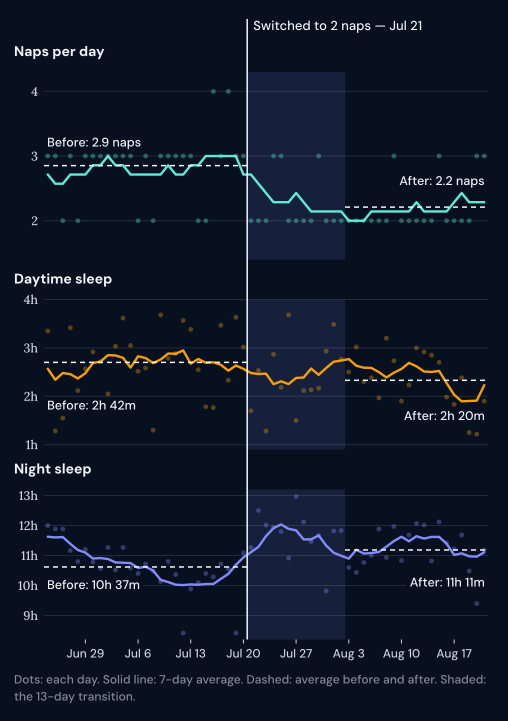
| Before | After | |
|---|---|---|
| Night sleep | 10h 37m | 11h 11m |
| Longest unbroken stretch | 8h 10m | 9h 44m |
| Night wakes per night | 1.00 | 0.68 |
| Morning wake | 6:38 AM | 7:06 AM |
Before: June 24 to July 20. After: August 3 to 21.
Dropping a nap didn’t cost him any sleep. Teething and travel had pulled his July nights down to about ten hours. Within a week of the switch they were at twelve, including four nights in a row with no wakes and one 12h 30m night. They settled between eleven and eleven and a half.
The third nap wasn’t holding his day together. It was eating into his night. Daytime and night sleep come out of the same 24-hour budget, so once the late nap was gone, that sleep went back into the night. And his mornings moved from 6:38 to 7:06. If you’re wondering which number changed our lives, it’s that one.
Why it doesn’t switch on a birthday
Cedric went back to three naps on three days inside the transition, and a handful more since. That’s the normal shape of a nap transition, and it’s why Ceddie never switches on a birthday. It keeps both nap counts in play and picks one each day from what’s actually been logged, adding a bridge nap when the day needs one.
He was ready to drop the nap. What Ceddie changed was how it felt to get there.
If you’re heading into it
- Watch wake windows, not nap counts. Stretch them a few minutes at a time. The nap count follows.
- Let naps get longer, within a limit. Longer naps are part of the switch, but cap them so they don’t eat into the night.
- Use a short bridge nap on short days. About thirty minutes, with a set time to wake them.
- Going back to three isn’t failure. It’s a short day, not a setback.
- Judge it on nights. Cedric’s nights showed it was working two weeks before his nap count settled.
That’s a lot to keep in your head for a few weeks on no sleep. It’s the bookkeeping Ceddie does for you.